Calm Through Turbulence: Anxiety Tools for Nervous Flyers
Managing Anxiety During Turbulence: Calm Flight Strategies, Mindset Tools, and Breathing Exercises
Turbulence can feel alarming even when a flight is operating normally. For nervous flyers, the body’s stress response may ramp up quickly—tight chest, racing thoughts, and a strong urge to regain control. The goal isn’t to “force calm” but to use practical tools that steady the nervous system, reframe catastrophic thoughts, and create a repeatable plan for bumpy moments. Below are mindset shifts, breathing exercises, and in-seat strategies that help reduce panic and make turbulence feel more manageable from takeoff to landing.
Why turbulence feels scary (and why the fear escalates)
Turbulence is uncomfortable partly because it’s unpredictable. When the cabin jolts, the brain can interpret sudden movement as a potential threat—even when the aircraft is performing exactly as designed. Add adrenaline, and a small drop can feel like a major fall.
The escalation often follows a familiar loop: scary sensation → catastrophic interpretation → more adrenaline → stronger body sensations → bigger fear. The practical aim is to interrupt that loop early using grounding, breath regulation, and a more accurate interpretation of what’s happening.
For general safety context and aviation guidance, see resources from the Federal Aviation Administration (FAA) and industry guidance from the International Air Transport Association (IATA).
A simple pre-flight plan that lowers baseline anxiety
Anxiety tends to hit harder when the nervous system starts the day already revved up. A small, repeatable pre-flight plan can reduce that baseline tension so bumps feel less “urgent” when they arrive.
- Choose a “calm kit”: headphones, an offline playlist, a puzzle game, a comforting scent (if allowed), and a short note of coping statements.
- Set expectations: mild bumps are common; discomfort does not equal danger.
- Pick a seat strategy: aisle for movement and easier access to the restroom, or window for a fixed visual reference—choose what reduces your personal triggers.
- Limit stimulants: reduce caffeine and heavy alcohol before flying to avoid jittery sensations that mimic panic.
- Practice one breathing pattern on the ground: familiarity matters when turbulence starts.
Quick toolkit for bumpy moments
| Tool | How it helps | When to use |
|---|---|---|
| Box breathing (4-4-4-4) | Slows breathing rate and reduces stress arousal | First signs of anxiety or when the seatbelt sign turns on |
| Extended exhale (inhale 4, exhale 6–8) | Signals safety to the nervous system and reduces hyperventilation | When heart rate spikes or hands tingle |
| Grounding (5-4-3-2-1) | Pulls attention away from catastrophic thoughts | During sustained bumps or spiraling worry |
| Muscle release scan | Reduces tension that feeds panic sensations | After a jolt or when bracing is automatic |
| Coping card statements | Replaces worst-case thinking with accurate reminders | Any time thoughts become “what if…” |
Breathing exercises to use during turbulence (step-by-step)
Breathing doesn’t need to be perfect to be effective. The goal is a slower, gentler pattern—especially a longer exhale—to reduce the body’s “alarm” signal.
- Extended-exhale reset (60–90 seconds): inhale through the nose for 4, exhale slowly for 6–8. Keep shoulders relaxed. Repeat for 6–10 cycles.
- Box breathing (2–3 minutes): inhale 4, hold 4, exhale 4, hold 4. Keep the breath gentle—avoid straining the holds.
- If dizziness appears: shorten the holds and focus on a slower exhale; over-breathing can worsen tingling and lightheadedness.
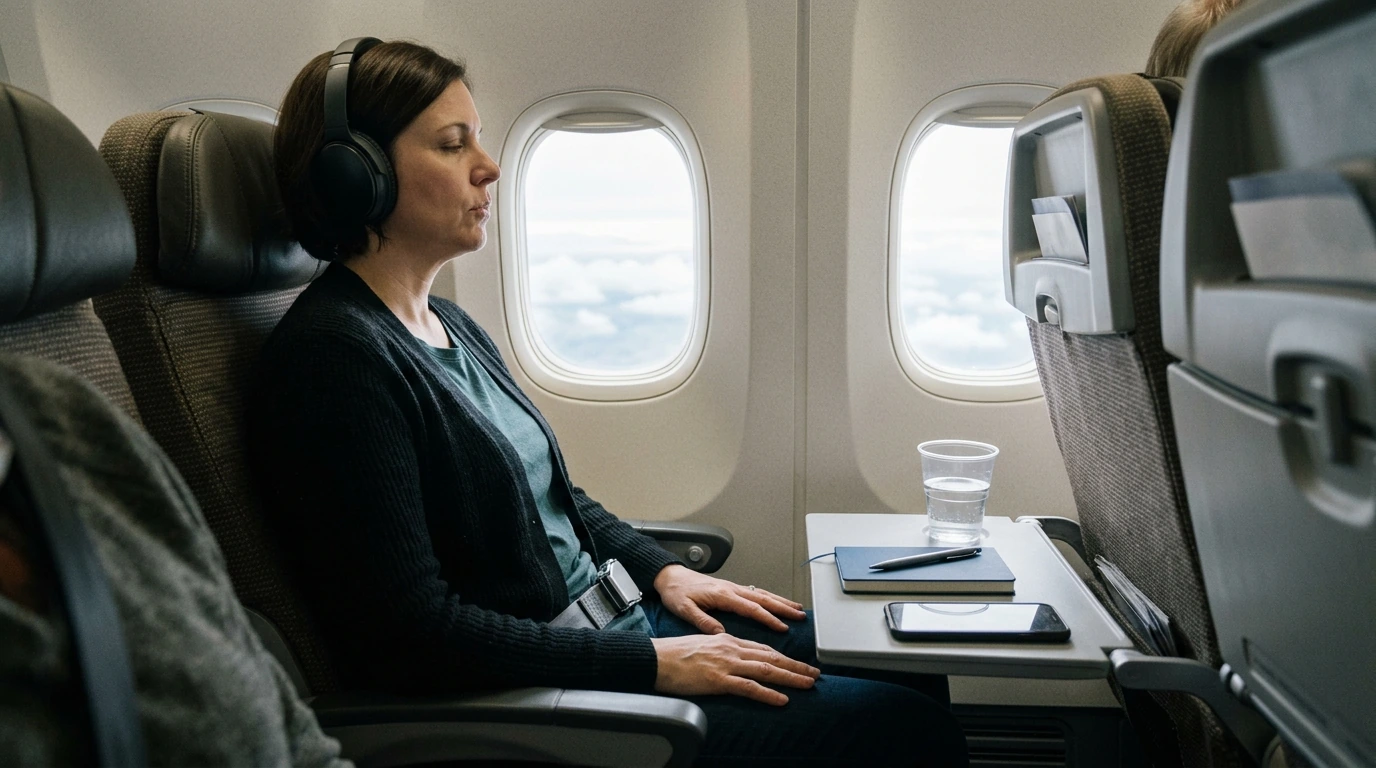
- Add a physical cue: press feet lightly into the floor or rest palms on thighs to anchor attention when the cabin moves.
For broader mental health education on anxiety and how it affects the body, the National Institute of Mental Health (NIMH) offers an accessible overview.
Mindset tools that reduce catastrophic thinking mid-flight
During turbulence, the mind often tries to solve uncertainty by jumping to worst-case conclusions. These tools keep thinking accurate and process-focused.
- Name the pattern: “My brain is predicting danger because movement feels unfamiliar.” Labeling reduces the emotional charge.
- Use probability language: swap “This is bad” for “This is uncomfortable, and planes are designed to handle it.”
- Shift from outcome to process: seatbelt on, breathing steady, posture relaxed, attention anchored—these are controllables.
- Use a one-sentence mantra: “Bumps are normal; I can ride them out one minute at a time.” Repeat it on each jolt.
- Time-box the fear: set a 3-minute timer, do one technique, then reassess. Many anxiety surges peak and fade when not fueled by panic behaviors.
In-seat body strategies that signal safety
What to do when anxiety spikes: a 5-minute turbulence protocol
When extra support makes sense
Helpful digital guides for calmer routines (in-flight and beyond)
- Managing Anxiety During Turbulence eBook — a quick-reference guide with calm flight strategies, mindset tools, and breathing exercises designed for bumpy moments.
- More Time, Less Stress: Time Management Mini-Course — useful for reducing pre-trip overwhelm by planning packing, airport timing, and travel tasks in a calmer way.
- Learn to Learn: A Meta-Learning Guide — helps build practice routines so coping skills become more automatic under pressure.
FAQ
Is turbulence dangerous to airplanes?
Turbulence is common, and modern aircraft are engineered and tested to tolerate expected turbulence loads. The biggest safety issue is usually injury from sudden bumps, which is why wearing a seatbelt when seated is strongly recommended.
What breathing exercise works fastest when turbulence starts?
Extended exhale tends to work quickly: inhale for 4, then exhale for 6–8 for about 60–90 seconds. Keep the breath gentle; if you feel lightheaded, shorten the exhale slightly and skip any breath holds.
How can nervous flyers stop catastrophic thoughts during a bumpy flight?
Label the thought (“My brain is predicting danger”), replace it with a realistic statement (“This is uncomfortable, and the crew handles it routinely”), and focus on controllables like posture and breathing. Set a 3-minute timer, do one technique, then reassess instead of chasing reassurance.











Leave a comment