Free Small Business Tools: Automate, Market & Stay Organized

Free Tools to Boost Your Small Business: Practical Automation, AI Productivity, Marketing, Workflow & Growth
Free software can meaningfully improve a small business when it is chosen for clear outcomes: faster execution, fewer manual handoffs, and more consistent marketing and follow-up. The simplest way to get results is to build a “small stack” that connects lead capture, quick replies, basic content production, and a single place to track work—then automate only what repeats.
Start with outcomes, not apps
Before downloading anything new, pick 1–2 bottlenecks that cost time or revenue. Common high-impact starting points include lead capture, follow-up, content creation, scheduling, customer support, and internal handoffs.
- Define a measurable target for the next 14 days (e.g., respond to new inquiries within 1 hour; publish 2 posts/week; reduce admin time by 3 hours/week).
- Audit what you already use (email platform, calendar, website forms, spreadsheets) so you don’t duplicate features.
- Set a simple rule: one system of record for contacts (a CRM or a spreadsheet) and one place for tasks (a project board or task app).
Quick picks: free tools by business job-to-be-done
| Goal | Free tool types | Typical result |
|---|---|---|
| Capture leads | Form builder + landing page + email signup | More inquiries and fewer missed contacts |
| Follow up faster | Shared inbox or CRM + templates | Consistent replies and higher conversion |
| Create content | AI writing assistant + design tool | Faster drafts and better visual consistency |
| Stay organized | Task manager + calendar automation | Fewer dropped tasks and clearer priorities |
| Track performance | Analytics + dashboard spreadsheet | Decisions based on numbers, not guesses |
Free automation building blocks that save hours
Automation works best when it starts from predictable triggers. If a process begins the same way every time, it’s a good candidate for a free-tier workflow.
- Build from reliable triggers: form submission, new email label, calendar booking, new order, or a new row in a spreadsheet.
- Use no-code automation platforms (free tiers often cover basic workflows like confirmations, list updates, and notifications).
- When integrations aren’t available, browser automation plus templates can handle repetitive admin (standard replies, renaming files, routine copy/paste).
- Create a “minimum viable automation”: one trigger, one action, one notification—expand only after it runs reliably for a week.
- Keep an automation log: purpose, trigger, actions, owner, and last tested date.
For marketing and sales fundamentals, the U.S. Small Business Administration’s marketing and sales guidance is a solid reference point when deciding what to automate first (lead capture and follow-up usually beat “nice-to-have” tasks).
AI productivity tools that deliver practical wins (without adding chaos)
AI tools shine when they reduce blank-page time and speed up first drafts. They’re far less helpful when they’re asked to “decide” anything sensitive or final.
- Use AI for outlines, first drafts, summaries, and rewrites—not for final claims, legal language, policies, or sensitive decisions.
- Create reusable prompts for recurring work: customer replies, proposals, product descriptions, meeting summaries, and social captions.
- Apply a lightweight review checklist: brand tone, factual accuracy, pricing/terms, and call-to-action clarity.
- Keep a single repository of approved snippets (FAQs, short bios, service descriptions, “about” statements) so outputs stay consistent.
- Protect data: don’t paste customer personal info, payment details, or confidential contracts into general-purpose tools.
For small-business safety basics, the NIST Small Business Cybersecurity Corner is a practical starting point for setting simple rules around accounts, passwords, and what information should never be shared in third-party tools.
Marketing on a free budget: consistency beats complexity
Most small businesses don’t need more channels—they need a repeatable cadence. A steady rhythm also makes it easier to measure what’s working.
- Use a weekly rhythm: one long post (blog or email) repurposed into 3–5 short posts plus one story/reel script.
- Use free design templates to keep visuals consistent; save brand colors, fonts, and reusable layouts.
- Organize content ideas in one board: Ideas → Draft → Scheduled → Published → Repurpose.
- Automate distribution where possible: schedule posts, auto-send welcome emails, and set reminders for follow-up.
- Track only action-driving metrics: inquiries, email signups, bookings, and top-performing topics.
If you use web analytics, keep setup simple and confirm your tracking is actually collecting data. The Google Analytics Help Center is useful for checking basics like conversions, events, and attribution without getting lost in advanced configuration.
Workflow tools that reduce dropped balls
Free workflow tools pay off when they make ownership obvious. If a task doesn’t have an owner and a next step, it tends to disappear into chat threads and half-finished notes.
A 7-day setup plan for real momentum
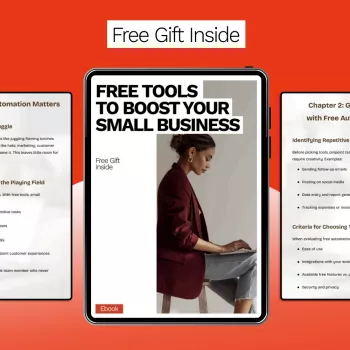
Practical ebook guide for building a free-tool stack (ready-to-use workflows)
- Free Tools to Boost Your Small Business | Practical Ebook Guide to free automation tools for small business, AI Productivity, Marketing, Workflow & Growth
- More Time, Less Stress: Time Management Mini-Course – Productivity Ebook with Pomodoro, Eisenhower Matrix & Time Blocking Strategies
- Learn to Learn: A Meta-Learning Guide | Digital Learning Guide PDF, Study Strategies eBook, Learning Style Planner, Educational Self-Development Toolkit
FAQ
Which free tools make the biggest difference fastest?
Start with lead capture and follow-up: a form or landing page connected to a contact list, plus a few reply templates. Next, add a single task board and a shared calendar, then implement one end-to-end automation so new inquiries never sit unnoticed.
Are free automation tools reliable for a small business?
Free tiers are usually reliable for simple workflows, especially when the trigger and action are straightforward. Test every automation, monitor it weekly, keep a manual fallback, and document what it does so the process doesn’t break silently.
How can AI tools be used safely for customer-facing work?
Use AI for drafts, rewrites, and summaries, then require a human review for accuracy, tone, and the final offer details. Avoid sharing sensitive data, and maintain approved snippets and a quick checklist before anything is sent or published.











Leave a comment